
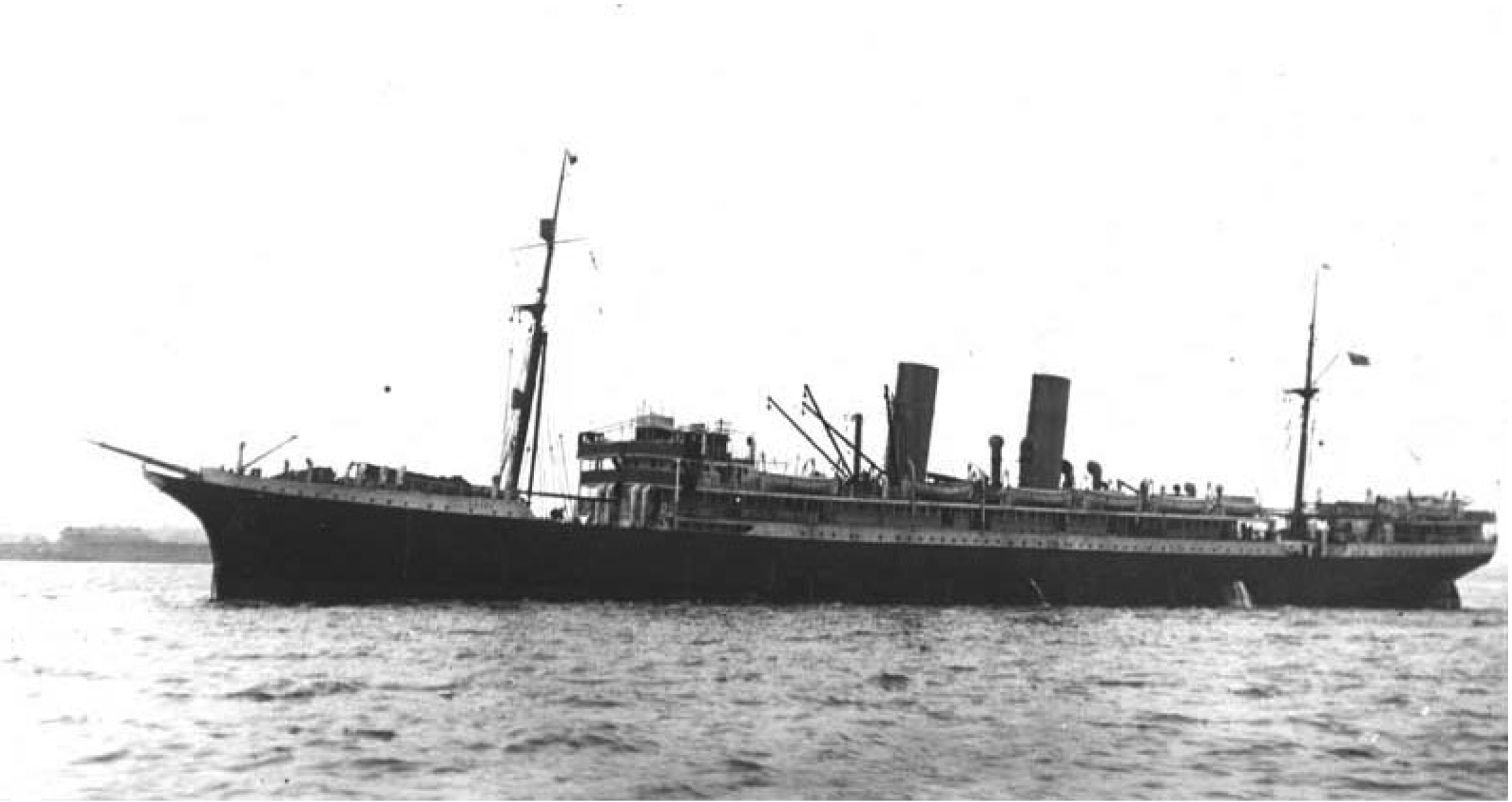
Steamship “Oruba,” built by the Barrow Shipbuilding Company Ltd. in 1889 for the Liverpool–Valparaíso route.
It is easy, standing on the banks of a river in southern Chile, watching a trout rise in perfect water, to assume that it has always been there, that these fish belong.
They do not.
South of the Equator, anywhere in the world, trout and salmon are not native, and Chile is no exception. Their presence here is the result of one of the most ambitious and improbable biological introductions ever attempted, a story that begins in the late nineteenth century and unfolds across oceans, continents, and mountain ranges.
The First Attempts: Hope Without Method
The earliest efforts were driven more by vision than by technique. In 1878, Chilean industrialist Tomás Urmeneta imported salmon eggs from Scotland. The attempt failed, as did others that followed. The science of fish culture was still in its infancy, and transporting fragile eggs across vast distances proved far more difficult than anticipated.
By 1885, the Chilean government had entered the effort, commissioning its consul in San Francisco to obtain salmon and trout eggs. This initiative connected Chile to the cutting edge of fisheries science in the United States, where Livingston Stone was redefining what was possible.
Stone, working at the Baird Hatchery on California’s McCloud River, had developed techniques that allowed salmonid eggs to survive long journeys, careful temperature control, constant monitoring, and disciplined handling. From this river came the stock of rainbow trout (Oncorhynchus mykiss) that would eventually travel far beyond North America, including to Chile.
Still, early Chilean efforts struggled. Eggs perished in transit, and those that survived rarely established breeding populations.
A Glimpse of Success
In 1888, a private initiative quietly changed the narrative. Isidora Goyenechea de Cousiño financed a hatchery at Chivilingo Creek, near Concepción. Brown trout (Salmo trutta) eggs were successfully hatched, and when a flood later destroyed the facility, the fish escaped into the wild.
Fifteen years later, in 1903, three trout were captured in that same creek. One was preserved and exhibited at the National Museum of Natural History. It was a small event, almost anecdotal—but it proved something essential:
Trout could survive in Chile. They could reproduce.
1905: The Defining Expedition
The real turning point came in 1905, when the Chilean government committed to a large-scale, coordinated introduction. The project was entrusted to Federico Albert, a naturalist with both vision and discipline, who traveled to Europe to secure eggs and expertise.
He returned with approximately 400,000 fertilized eggs; Atlantic salmon (Salmo salar), brown trout (Salmo trutta), and rainbow trout, along with two fish culturists. One of them, a German-Polish specialist named Pedro Golusda, would become central to the success of the entire operation.
The eggs departed Europe in early March aboard a steamship bound for Chile. They were packed in insulated crates, cooled with ice, and tended constantly. Every few days they were washed, sorted, and disinfected. Dead eggs were removed with precision. It was a process that demanded discipline and vigilance.
But as the ship crossed into tropical latitudes, the situation began to change.
The eggs started to develop faster than expected. Hatching was approaching, and the ship still had weeks of travel ahead, including the long route around the Strait of Magellan.
Waiting was no longer an option.
The Andes Crossing
Albert and Golusda made a decision that would define the outcome of the entire project: they would disembark in Buenos Aires and cross Argentina towards the Andes with part of the shipment.
What followed was an extraordinary journey.
The eggs were transferred from ship to rail, from rail to carts, and from carts to mule trains. In the lowlands, temperatures approached 40°C. The crates were wrapped in canvas and packed with straw and ice to preserve them. At higher elevations, the problem reversed, freezing temperatures forced them to remove the ice and insulate the eggs with sawdust.
At nearly 4,000 meters, they were caught in a snowstorm. Later, a landslide blocked their path. Then came a damaged bridge over the Aconcagua River.
Every stage of the journey presented a new risk. Every decision mattered.
After 38 days of travel, they finally reached the hatchery at Río Blanco in Chile.
Not Ready—But No Time to Wait
What they found there could have ended the entire effort.
The hatchery was not ready.
Water systems were broken. The incubation room was in poor condition. There were no proper incubation boxes.
And the eggs were about to hatch.
There was no time for frustration. Albert and Golusda went to work immediately. Albert focused on restoring the water supply, while Golusda improvised incubation equipment and repaired the facility. They worked without interruption for 24 hours.
When the eggs were finally placed in water, they began to hatch within two hours.
They had arrived just in time.
The First Release
The second shipment of eggs arrived days later, completing the operation. Despite everything—the heat, the cold, the delays, the mechanical failures—losses were minimal.
By October of that same year (1905) , the results were tangible. Roughly 200,000 juvenile fish were recovered from the rearing ponds. Nearly all were released into rivers across central and southern Chile: the Aconcagua, the Maule, the Cautín, the Toltén.
Golusda later described transporting the young fish in oval wooden barrels, a method he considered unmatched for keeping fish alive during travel. These early stockings were simple by modern standards, but they were enough.
The fish took hold.
Although Atlantic salmon (Salmo salar) were successfully transported, hatched, and released in Chile beginning in 1905, there is no evidence that they established self-sustaining wild populations in any Chilean river system. In contrast, trout species—particularly brown trout (Salmo trutta) and rainbow trout (Oncorhynchus mykiss)—adapted readily and formed stable, reproducing populations across much of the country. Interestingly, it was not until much later that a salmon species would successfully naturalize in Chile: the Chinook salmon (Oncorhynchus tshawytscha), introduced in the late twentieth century, has since established strong wild runs in several Patagonian rivers. This contrast highlights both the complexity of salmonid life cycles and the unpredictable nature of species introductions outside their native range.
A Legacy Written in Water
Over time, trout adapted to Chile’s rivers with remarkable success. They spread, reproduced, and established self-sustaining populations across vast watersheds. Today, Chile offers some of the finest wild trout fishing in the world—a fact that would have seemed improbable to those early pioneers.
The story is one of persistence, but also of transformation.
Livingston Stone made it possible to move fish across oceans. Pedro Golusda made it possible for them to survive the journey. Federico Albert ensured the vision became reality.
And yet, the story carries a quiet reminder.
These fish do not belong here in the original sense. Their presence has shaped ecosystems as much as it has shaped fisheries. What was once an experiment is now a defining feature of the landscape.
Standing in a Chilean river today, watching a trout rise, you are witnessing the result of that history, one that continues to evolve, and one that asks, in return, for care, respect, and stewardship.
Source: Historia de la Piscicultura Río Blanco by Gabriel Dazarola Metzger, 2019